What causes bread dough to rise? ethanol carbon dioxide isopropyl alcohol sugar
What causes bread dough to rise?
fifteen January 2021 | Gary Tucker, Fellow
A great deal is written about the style that yeast produces carbon dioxide to leaven bread dough during proof. However, there are other gases such as ethanol and steam that are vital during the oven stages of staff of life making. These gases tend to exist forgotten but without them it would not be possible to bake bread of the quality we await. Their role increases in importance equally the bread reaches the end of the bake time when its structure becomes more than susceptible to collapse. In this article I'll discuss the different gases that are essential in helping bread dough to rise during blistering.
There are many means of making bread from the bones ingredients of flour, h2o, yeast and salt, from labour-intensive artisan bread to loftier-throughput sandwich breadstuff. However, at that place are three aspects that are critically important to any type of staff of life making, and information technology all starts in the mixer:
- The mixing action entrains numerous air bubbles into the dough that can be inflated during proof and baking.
- Dough development takes place during the mixing process to convert the flour proteins into a gluten matrix that has the elasticity to allow the bubbles to aggrandize in later stages.
- Gases are generated by yeast activity and/or chemical leavening agents to expand the bubbles and create the desired aerated breadstuff construction.
The role of gases in expanding the bubbling during proving and baking is fascinating merely commonly focuses on yeast converting sugars to carbon dioxide (CO2). Yeast metabolism in dough is complex and involves a short aerobic fermentation phase where oxygen from the bubbles is used up followed by a much lengthier anaerobic phase. The details of this are explained later. The mechanisms assist to explain why the dough book initially shrinks, why there is a lag earlier the dough gradually increases in volume and how oven spring takes place. However, as mentioned in that location are other leavening gases that play a vital role, specially during baking, and without them the breadstuff is certain to collapse in the oven. This commodity highlights the part of the other gases together with the mechanisms by which those gases piece of work to inflate the bubbles.
Background inquiry
Amid the many enquiry papers on bread dough leavening in that location a couple that are worthy of mention. These introduced the concept that gases other than carbon dioxide played a key role in expanding gas bubbling in dough. Moore and Hoseney (1985) calculated the carbon dioxide volume from expansion of the gas bubbles and concluded that carbon dioxide lone did not explain the increase in volume from dough to staff of life during baking. They thought that ethanol was significant, particularly effectually seventy°C when its vaporisation rate increased rapidly. A farther publication on this subject was by Bloksma (1990) who compared the Moore and Hoseney calculations with his own on partial pressures of gases during blistering. Bloksma included carbon dioxide, ethanol and water in his own calculations of thermal expansion. He concluded that water (in the form of steam) contributed more than half of the oven bound book, with ethanol and carbon dioxide responsible for much of the residual. These calculations were fabricated up to seventy°C because this was the phase when Bloksma considered that oven jump ended and farther volume increase was negligible.
Gases involved in breadstuff making
Equally mentioned previously, during breadstuff baking there are several gases that contribute to the leavening of breadstuff dough. Carbon dioxide is the primary gas associated with yeast leavened bread, still, other gases that play a role are ethanol, nitrogen and steam. There is also a small-scale contribution from depression molecular weight volatile compounds formed during fermentation. The main gases and their roles are described in Table one.
| Gas | Clarification |
|---|---|
| Carbon dioxide (CO2) | Generated by yeast during aerobic and anaerobic fermentation of glucose. Amylases convert starches in the flour to maltose, which is farther converted to glucose by maltase from the yeast. Anaerobic fermentation is the dominant result. |
| Ethanol (C2HvOH) | Generated by yeast during anaerobic fermentation of glucose. Molar quantities of ethanol are the same as for COtwo during anaerobic fermentation. Ethanol boils at 78.4°C so its influence on dough expansion is significant as the dough temperature approaches 70°C. |
| Water (H2O) | Approximately twoscore-60g is lost from a 900g dough piece (to make an 800g lidded loaf) during baking. Much of this volition exist water which will turn to steam late in the oven. |
| Nitrogen (N2) | Nitrogen is left in the bubbles when oxygen is used by both yeast and ascorbic acid. Nitrogen expands as information technology increases in temperature. Dissolved gases (oxygen and nitrogen) will as well come out of solution every bit the dough liquid increases in temperature. |
| Other volatiles | Volatile molecules are as well generated from fermentation, such every bit carboxylic acids, aldehydes, ketones and alcohols. |
Table i: Gases released from bread during baking
Carbon dioxide (CO2)
Carbon dioxide generation takes place during 2 stages of fermentation because yeast can metabolise both aerobically and anaerobically. Aerobic fermentation is the starting time pathway and will continue until all the oxygen is used up and the conditions in the dough become anaerobic. There is competition with ascorbic acid for oxygen, added to increase gluten oxidation during mixing, and this limits the extent of aerobic fermentation. The yeast get-go metabolises glucose and oxygen to carbon dioxide and water, as in Equation 1. Glucose is generated by enzymic pathways from the starch in the flour to maltose and so to glucose. Oxygen comes from the air in the bubbles entrained during mixing.
C6H12O6 + 6O2 → 6CO2 + 6HtwoO Equation ane
Having used the available oxygen, subsequent fermentation during proof takes place with the dough in an anaerobic condition. Yeast obtains the oxygen needed directly from the glucose, co-ordinate to Equation 2. This is by far the almost ascendant stage in yeast fermentation. Equal tooth quantities of carbon dioxide and ethanol are produced from glucose breakup, which are pregnant, and discussed subsequently.
Chalf dozenH12Ovi → 2COtwo + 2C2H5OH Equation 2
Information technology is important to annotation that the carbon dioxide produced from either fermentation manner does non go straight into the gas bubbles. At proof temperatures of 32-38°C, carbon dioxide is soluble in water to a level of almost 1.0 thou/kg. It offset dissolves into the aqueous phase that surrounds the yeast cells and continues to deliquesce until the liquid becomes saturated. During the aerobic phase, oxygen is used from the air bubbles and this reduces the pressure inside each bubble. They first shrink by nearly 20% equally they now only contain nitrogen. Simply when the water is saturated with carbon dioxide tin it enter the bubbles to inflate them. Carbon dioxide tin also dissolve in organic solvents such every bit the vegetable oil used in staff of life making. This helps in a small way to increment the quantity of dissolved carbon dioxide in the dough.
Ethanol (C2HfiveOH)
Equation 2 shows that ethanol and carbon dioxide are produced in equal molar quantities during anaerobic fermentation. Ethanol is readily soluble in water and organic solvents, to the extent that all the ethanol produced during fermentation dissolves into the liquid phases surrounding the gas bubbles. It boils at 78.4°C and is likely to take left from the bread soon after its boiling point of 78.four°C is reached. The charge per unit of ethanol evaporation is probable to be at its highest when the internal core temperature is above 70°C.
The part of ethanol in dough behaviour is complex and is a discipline for further investigation. Ethanol is known equally a universal solvent considering it allows both polar and non-polar compounds to dissolve. Information technology therefore increases the solubility of carbon dioxide so that more can dissolve and be available to release from solution as the dough temperature rises during baking. This contributes to the sudden oven spring that happens early in the baking process. Ethanol also increases the solubility of the gliadin wheat protein fractions, which may have an impact on the rheological behaviour of dough considering the gliadins are thought to confer extensibility to dough. Some other property of ethanol is the part it plays in softening bread crumb.
Steam (Htwo0)
Water boils at 100°C and so volition be released later into the baking procedure than ethanol (BP 78.4°C) or carbon dioxide (BP -56.half-dozen°C). By the fourth dimension steam is released into the bubbling information technology is likely that the construction of a baked product will have increased in 'viscosity' substantially considering of starch gelatinisation that takes place above lx°C. Withal, the thin gas bubble walls volition still incorporate a lot of water and are very soft at this phase. Without the increase in pressure from ethanol and steam it is likely that the fragile bubbles will collapse.
Nitrogen (Northward2)
Air contains approximately 20% oxygen and lxxx% nitrogen. Oxygen is used up by the yeast during its aerobic phase and is replaced in the gas bubbles by carbon dioxide in one case the liquid surrounding the gas bubbles is saturated. Nitrogen is unaffected past yeast fermentation and will expand as the bread temperature rises. The contribution of nitrogen to bubble expansion is less significant than with the gases that come out of solution. Nitrogen expansion is uniform with temperature compared with the instant volume increase when a gas comes out of solution.
Each gas exerts its force per unit area influence at a different phase in the oven, and without these gases working in series it is non possible to create a nibble construction based on such a delicate network of bubbles.
When are the gases released?
This is another interesting question. Soluble gases such as carbon dioxide and ethanol dissolve into the aqueous and organic liquids surrounding the bubbling. The extent of their solubility depends on pressure and temperature. As the dough temperature increases, the gases are forced out of solution and inflate the gas bubbles. If a bubble breaks and coalesces with an adjacent bubble, the gas is retained within the larger chimera and is not lost. Merely a small amount of gas is lost from the top surface of the dough. Experiments accept shown that this is non a significant quantity and but occurs towards the cease of proof and more so with less well developed doughs.
Oven spring takes place quite early into the baking process. This is when a sudden increase in pressure occurs inside the bubbles, which causes the dough to force upward speedily. Expansion slows down when the sides and meridian surfaces dry out out, gear up difficult and they resist the upwards forces. Farther book increment is limited and, with pan bread, causes a interruption in the side crusts towards the upper edges. This pressure increase is caused mostly by carbon dioxide coming out of solution but there is some contribution from nitrogen expansion and ethanol. Oven leap is usually completed in the starting time third of the bake.
The internal network of bubbles in the breadstuff nibble remains delicate for the duration of the broil. Without a positive pressure to maintain them, the chimera walls are soft enough and then they can hands collapse. The bubble pressure is first maintained by carbon dioxide because it boils at the everyman temperature (-56.6°C), followed by ethanol (78.4°C) and finally past water (100°C). Nitrogen expansion takes place gradually as the dough temperature increases throughout. Each gas exerts its pressure influence at a different stage in the oven, and without these gases working in series information technology is not possible to create a crumb structure based on such a frail network of bubbles. Figure 1 illustrates the temperature rise in an 800g loaf of sandwich bread during baking, with the approximate regions in which the gases take their influence on maintaining the chimera pressure. Effigy 2 is a micro CT (computerised tomography) image taken for a 2cm cube from a white sandwich staff of life that shows the fine gas bubble structure. It would not be possible to create such fine and delicate nibble structures without a series of gases to maintain the internal gas pressures.
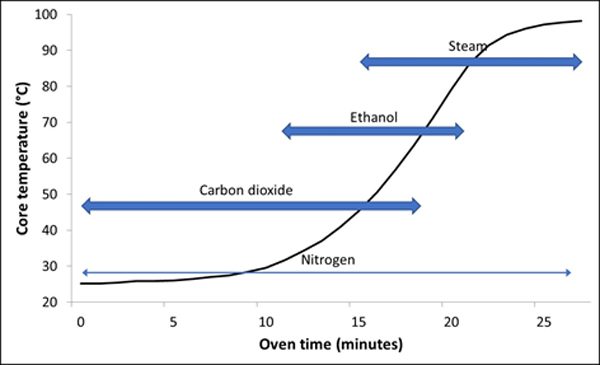
Fig 1: Time of influence of the dissimilar gases during baking of white sandwich bread
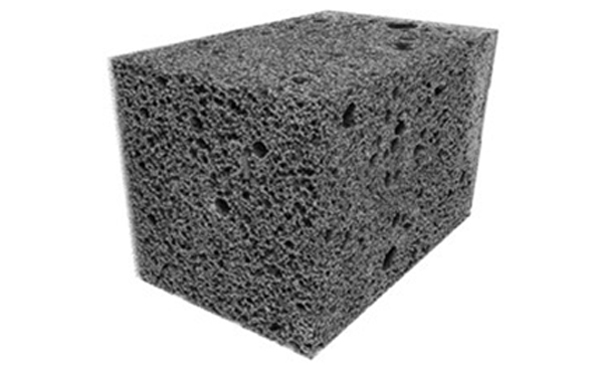
Fig ii: Micro CT image of the porous structure in a 2cm cube cutting from of a white lidded loaf
Foam to sponge conversion
In that location is one last change in the bread nibble structure that is essential to avoid collapse of a loaf afterwards baking. This is particularly important with bread broiled in lidded pans where crust thickness and strength are much less than with open baked crusty products. Every single gas bubble must break to allow the hot gases out. If the intact gas bubbles cool, the result will be a loss in force per unit area and enough volume reduction to cause the side walls to collapse inwards. This change – where the bubbles pause to allow the escape of their gases - is known as the foam to sponge conversion and is thought to happen simply a few minutes before the staff of life exits the oven. The effect is effectively one very circuitous gas bubble made from all the interconnected smaller gas bubbles.
Towards the end of the oven process, and merely before the foam to sponge conversion, the gas bubbles contain a mixture of gases including nitrogen, steam, carbon dioxide, ethanol and some volatile organic compounds. It is likely that steam is mostly responsible for breaking each of the gas bubbles in bread; converting the structure from a closed cream to an open sponge. When water changes into a gas it increases in book substantially. The later stages in baking are when the bread is hot enough for steam generation to occur rapidly.
This conversion is an essential part of the baking process and enables the gases to escape to atmosphere and exist replaced by cooler air. Without this escape pathway each bubble suffers a massive collapse in force per unit area and volume every bit the gases cool.
Summary
The office of carbon dioxide, ethanol, nitrogen and steam is fascinating during mixing, proof and baking. Information technology would not exist possible to bake bread with a fine network of gas bubbles without each of these gases working together to maintain the pressure inside the bubbles. Carbon dioxide is responsible for the volume increment in dough during proof and for much of the oven spring that happens early on into the bake. Ethanol and steam are vital to maintain pressure within the delicate bubbling towards the later stages of blistering. Finally, and afterward the starches take gelatinised and started to set, steam creates force per unit area that breaks each of the bubble walls to release the gases into the oven atmosphere. Air rushes back into the newly created single interconnected bubble to brand the breadstuff structure more resilient to plummet. By understanding these dissimilar mechanisms during mixing, proof and baking it is possible to blueprint recipes and processes, and to solve baking problems more hands.

About Gary Tucker
Gary Tucker is a Swain at Campden BRI and has worked for the visitor since 1989. He studied Chemical Engineering at Loughborough Academy and is a chartered chemical engineer.
Read more...
Understand baked products better with our baking courses
Sympathize baked products improve with our baking courses from blistering basics to biscuits and across. Take a look at the full range of high quality training that's delivered past our experts to develop and abound your workforce's skills and talents.
cummingsstorturly01.blogspot.com
Source: https://www.campdenbri.co.uk/blogs/bread-dough-rise-causes.php

Postar um comentário for "What causes bread dough to rise? ethanol carbon dioxide isopropyl alcohol sugar"